The Dust in the Chamber
and the Words That Became Obsolete
A cheap vacuum's transparent chamber showed what no specification could prove: the actual trace of invisible work.
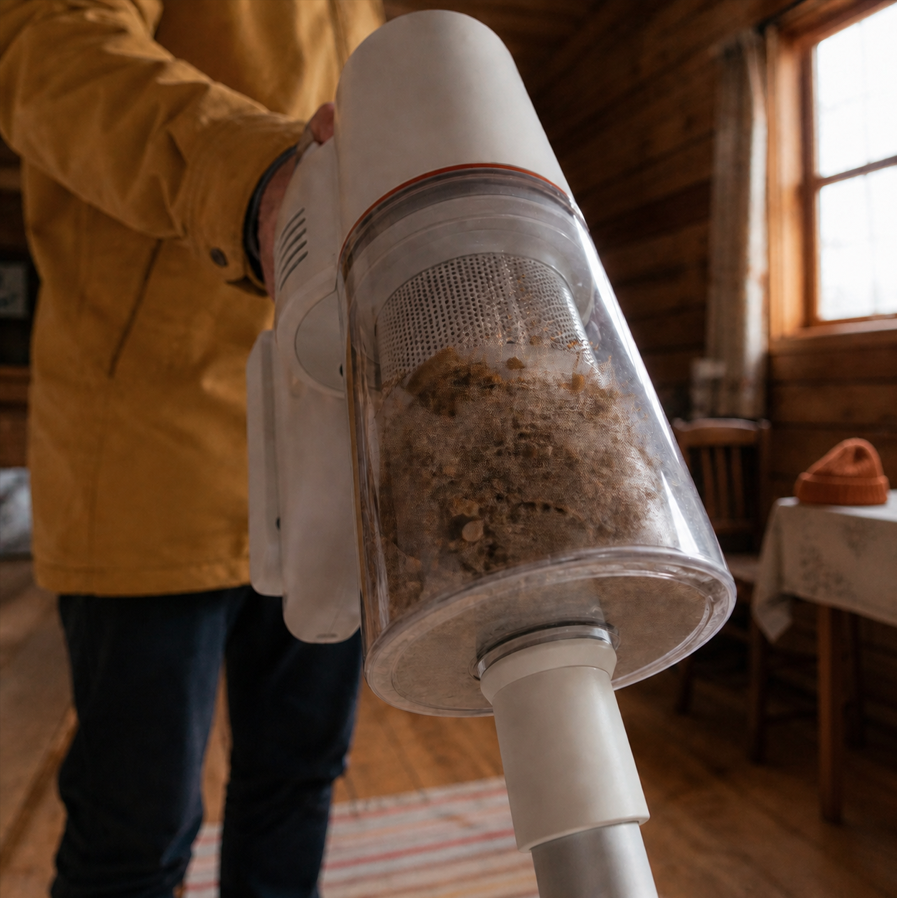
At the country house, I ran a vacuum cleaner over the wood floor.
My wife had already swept it earlier. The floor looked clean.
The vacuum was cheap. I was not sure it would do much.
But it had one feature I hadn't paid attention to before: a transparent dust chamber.
As I finished the first room, I looked at the chamber.
Dust and sand. Not a little. Enough to see clearly.
From a floor that looked clean.
From between the wood boards. From gaps I couldn't inspect even if I tried.
The vacuum had pulled out what was invisible.
I moved to the second room. Same result. The chamber filled again.
At that moment, something shifted.
I stopped wondering if the vacuum was working. I stopped thinking about specifications, power ratings, or online reviews.
The dust in the transparent chamber was not evidence of performance.
It was the performance.
There are many words we use to evaluate systems: utility, reliability, trustworthiness.
All of them require belief upfront.
Sometimes it is enough to capture dust in a container, and all those fancy words become obsolete.
The transparent chamber gave me two things at once.
First, it showed that the vacuum was doing its job.
Second, it showed what "clean" actually meant. More dust than I expected. Hidden between boards. Invisible until collected.
This is not just about vacuum cleaners.
Many systems ask for trust before they prove anything.
They show dashboards. Metrics. Reports. Green checkmarks.
But none of that is the same as showing the trace of the work itself.
Not a summary.
Not an indicator.
The actual thing that was collected, extracted, or changed.
When I build systems, I think about effectiveness now differently.
The question is not: does it work?
The question is: can someone see that it worked without needing to trust the claim?
Organizations often announce process completion. Projects declare milestones reached. Teams report tasks finished.
But where is the dust in the chamber?
Where is the thing that was there before, now collected and visible?
AI tools give confident answers. They sound finished. They look polished.
But they rarely show their working. What was checked? What was discarded? What assumptions were made?
No transparent chamber. Just the result.
The vacuum cost very little.
It looked unreliable.
But it did one thing that more expensive systems often do not:
It made its work impossible to doubt.
Not through promises.
Through proof you could hold in your hand.