The Lost Function
and the Sponge That Still Had All Its Parts
A shower sponge had the same mesh, the same string, and no function left.
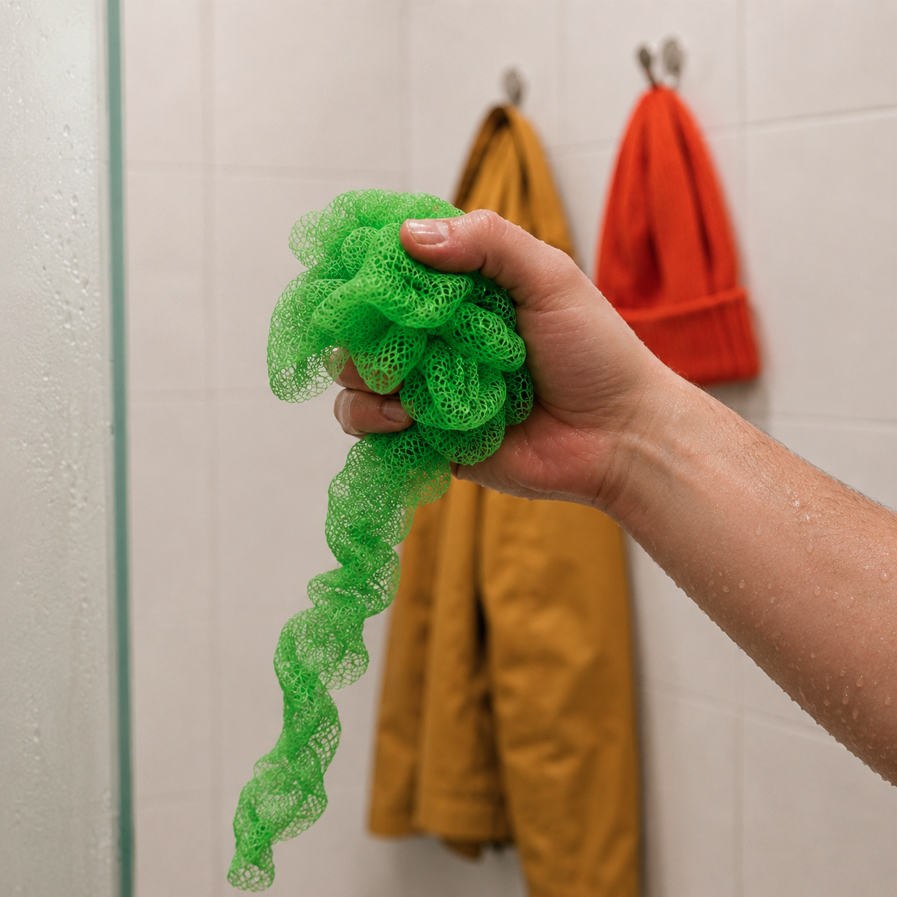
My shower sponge broke.
Not because it wore out. Not because it rotted. All the elements were still there: the same mesh, the same string. Physically, it was intact.
But the function was gone.
It started with one loose end sticking out of the bow. I thought maybe a child had pulled it. Nothing serious.
I picked up the sponge and started washing.
It fell apart in my hand.
All of it.
In one moment.
I put it back together. I tied the string again. I started washing again.
And it fell apart again.
At first, while I was only looking at it, the difference was almost invisible. Broken sponge. Whole sponge. Same material. Same mesh. Same string.
Then I put soap on it and pressed it against my body.
That was when the experience changed.
It slipped out like a piece of soap. I could not press it properly, because every time I pressed harder, it opened even more. Then I got slightly angry and tried to squeeze it in my fist.
All the foam came out.
The sponge became almost dry again.
Then I lost patience, unrolled it into a long line, and tried to wash with the line.
That also did not work.
There was not enough soap inside it. It did not hold anything. It did not behave like the object I had been using a few minutes earlier.
That was when I understood the first thing:
I was looking at the sponge as a shape. But it was a construction.
From the outside, it looked like a bow.
Inside, there were layers, tension, volume. Something that held foam under pressure and did not spread apart in the hand.
It was not mesh tied with a string.
It was an assembly with logic.
A logic I had never seen while it was working.
I tried to put it back together visually, roughly the way it used to look.
It looked similar.
But it was not the same.
Because I restored the appearance.
Not the mechanics.
This happens to systems all the time.
The team is there. The tools are there. The process is documented. Roles are assigned. Meetings are in the calendar.
Visually, everything is assembled.
But under the first real pressure, it falls apart.
The foam comes out immediately. The shape does not hold. You cannot keep it in your hands.
And only then it becomes visible:
what was restored was not the mechanics.
It was the appearance of mechanics.
Because the hidden construction did not live in the elements.
It lived in the assembly.
In the correct assembly, which somebody once knew, but which I, as the user, had never seen while everything worked.
I did not throw the sponge away.
The usual logic is simple:
broken, replace it.
unclear, do not waste time.
no instruction, buy a new one.
I felt something else.
As long as the material is still alive, I am not ready to declare the object dead.
Not out of principle. Not out of saving money.
Because throwing it away would mean admitting that I never understood how it worked.
And I am not ready for that yet.
If I put everything into a little bag, I could call it a shower sponge.
The material is the same. The name is the same. The purpose is supposedly the same.
But in reality, no.
The shape can be restored. The function cannot.
Because function does not live in the elements.
Function lives in the correct assembly.
And to bring it back, I do not need to repeat the shape.
I need to find the hidden principle.
A thing without the right assembly loses its function.
Even when physically, everything is still there.
I still have not found how to tie the sponge back correctly.
For now, it is just one long piece of mesh.
But I am not giving up.
It is still new.
And somewhere inside that mesh, there is still a shower sponge.