The Roll
and the Process That Gave It Weight
When access becomes free, the product survives. The process that gave it weight does not.
I was lying in bed when I noticed the scanner on the shelf above me.
I bought it more than twenty years ago. The intention was clear: scan the family archive. Photographs from the film era, still sitting in albums and boxes, still only existing on paper. Move them into the digital world. Make them shareable. Back them up somewhere safe.
The scanner works. I did start, once. Then university began. Then work. Then marriage. Then another degree. Life accumulated in the gap. Roughly half the archive made it through. The rest is still on paper.
But looking at it from the bed, I did not feel guilty about the unfinished project. I felt something else, something harder to name.
I remembered how photographs used to work.
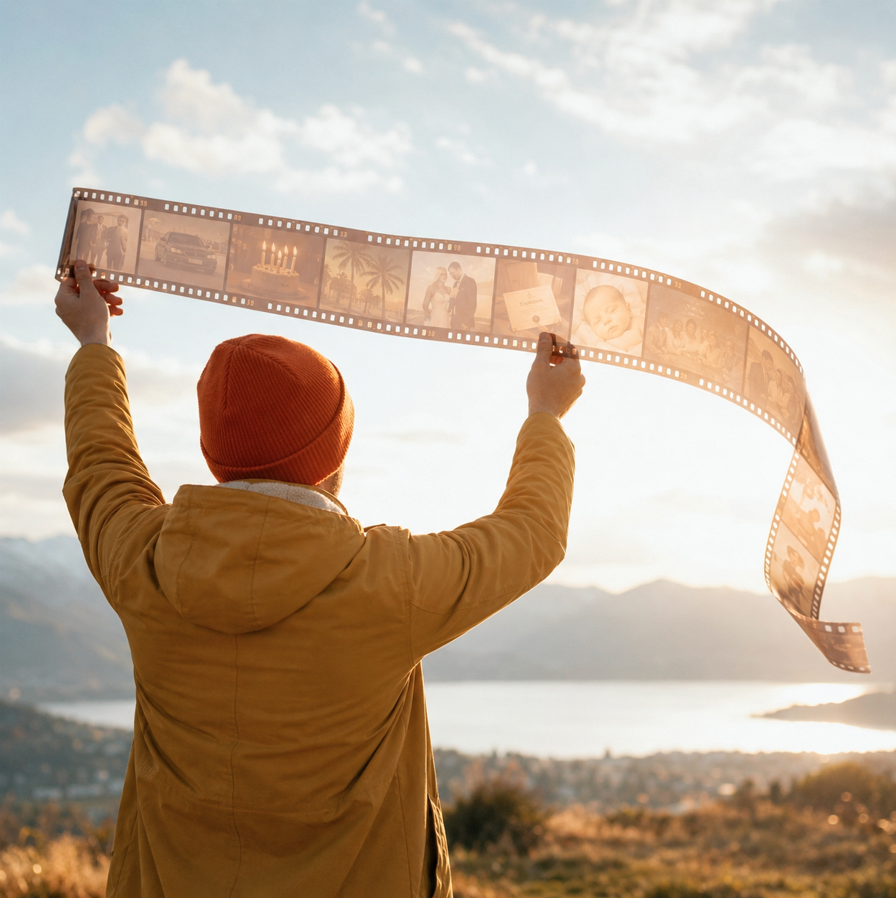
My family had a camera before digital existed. Film. Limited frames per roll, twenty-four or thirty-six, and then it was finished. You could not check if the shot came out. You could not take forty versions and pick the best one. You chose the moment. You pressed the button. And you waited.
When the roll ended, it was an event. You took it to be developed. A few days later you came back. The envelope with prints was something you actually opened slowly.
Some shots were blurred. Some had the wrong exposure. Some captured nothing useful. Those hurt. A missed moment was actually missed.
My mother and I would sit together with the prints. We would go through them one by one. We rarely wrote anything on the back. That is its own small loss. Then we would put them into albums, plastic-sleeved pages or the kind with paper corners, one photograph at a time. It was slow. It was deliberate. The album was a result of many small decisions.
That ritual is gone.
Not because photographs became worse. Because they became free. No limit on frames. No waiting. No cost of getting it wrong. You take a hundred shots at a birthday party without thinking. You keep all of them. But the three that mattered are now somewhere inside a hundred, unsorted.
The scanner made complete sense when I bought it. The mission was obvious: move the archive across. I started. Then life moved faster than the project. And somewhere in the gap between starting and returning, the world around the scanner changed. The new photographs no longer needed it. They were born digital. The archive I wanted to preserve was now a closed chapter, no longer producing new content.
The bridge still works. There is just nowhere it needs to go.
About a month ago, I was running interviews for an open position. Around ten candidates over a few weeks. After dozens of interviews over the past year, I have developed a kind of pattern recognition I did not have before.
Some candidates answer from memory and experience. They pause, they search, they sometimes get things wrong. But the answer belongs to them.
Others start differently. The eyes shift. Not toward you, toward somewhere else. The gaze moves left to right, left to right, at a pace that is not thinking. It is reading.
And then the answer arrives. Structured. Precise. Using terminology that someone with two weeks in the field should not know. It sounds expert. It sounds almost too complete.
Then you ask a follow-up. A small one, connected to what they just said. And the whole thing collapses. They ask you to repeat the question. They rephrase it back to you. They lose the thread entirely. Because there was no thread. There was only text that appeared on a screen somewhere outside the frame.
The knowledge was accessible. The thinking was not there.
This is the same mechanism.
When film was expensive, every frame required a decision. That decision was the skill. The constraint was not the problem. The constraint was what made the photograph mean something.
When knowledge required effort, finding and synthesizing the answer was the skill. That process was not inefficiency. It was how understanding formed.
Remove the constraint and you do not just make the product cheaper. You dissolve the process that built the thing the product was supposed to represent.
The photograph does not disappear. You get more photographs than ever. But the act of choosing, of committing to a moment, of sitting with your mother and deciding what goes into the album, that is gone.
The answer does not disappear. You get more answers than ever. But the act of forming one, of searching and being wrong and adjusting and arriving somewhere, that is gone too.
What remains is output without the process that gave output its weight.
The scanner on the shelf is not broken. It is just a bridge to a world that stopped needing a bridge.
The question I keep returning to: when the process disappears long enough, does the capacity to run it disappear too? The muscle that was never used. The roll that was never finished.