The Trim Line
and What the Wind Already Knew
A trimmed lawn signals care to the human eye, but the air is measuring something else entirely.
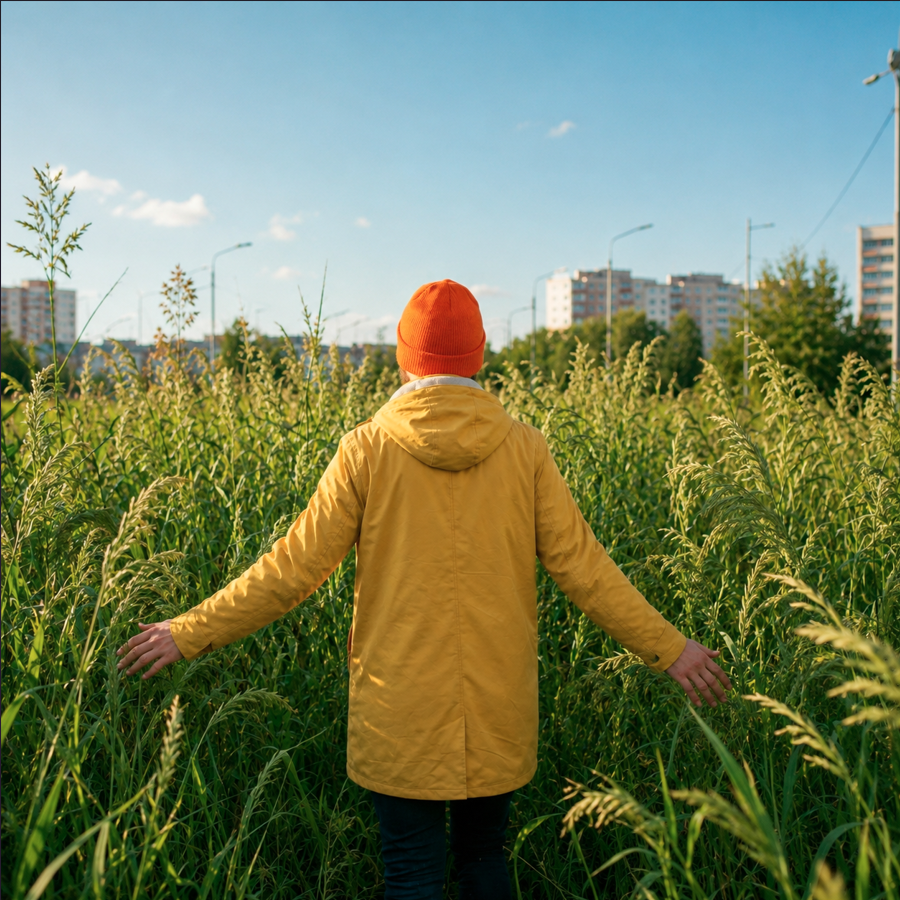
Krasta iela, early June. The overpass where Island Bridge (Salu tilts) meets the city.
On both sides of the ramp, large curved embankments of grass. When mowed, they look like a clean, flat green surface. When they are not, the grass stands at door-handle height. Sometimes higher.
I drive past this spot often. A few weeks ago, I noticed the mowers were out. Small tractors moving slowly around the perimeter, cutting everything down to an even surface.
I watched them work. And something in me could not decide whether this was a good thing.
The first time I saw uncut city grass was in Bulgaria. We were walking through the city and I noticed the grass on the verges just standing. Tall and uneven. My first instinct was: nobody takes care of this.
I did not think about it further. I filed it under "different culture" and moved on.
Later, traveling through other European cities, I saw the same thing. Some places just did not mow. I started to read about it. And I found something that changed the frame.
Tall urban grass catches particulate matter. The fine particles from cars, from exhaust, from construction. In some conditions, it catches them more effectively than a short, regularly trimmed lawn. Some cities have deliberately stopped mowing certain green strips. Not because of budget cuts. Because the uncut grass was working better.
I sat with that for a while.
Riga had a difficult few days recently. Wind came in strong. Dust was visible in the air, particles hanging in gusts, the kind of days when you feel it in your throat and on your skin.
During those same days, municipal crews were out on Krasta iela, cutting the grass at the base of the overpass.
Nobody did anything wrong. The workers showed up, did their job, went home. The curved embankments are now trim and even. They look cared for.
But I kept thinking: the city paid to remove something that was, for those windy days, filtering the air for free.
This is not a complaint. I understand why trimmed grass is trimmed. It signals maintenance. It signals that someone is responsible for this space. It says: we are watching this. We keep things in order.
That signal matters. It is not nothing.
But there are two different audiences for that signal.
One audience is the person driving past. For them, the trim line says: this city is looked after.
The other audience is the air. And the air does not read trim lines.
We often use tidiness as a proxy for function. If something looks maintained, we assume it is working. If something looks overgrown, we assume something has gone wrong.
But appearance and function are not always the same measurement.
A clean desk can mean efficient work. It can also mean no work.
A trimmed lawn looks productive. An untrimmed one can be producing something invisible.
The short lawn signals to the eye. The tall grass works on the air. The city sees the first. The wind knows the second.
I am not arguing for abandoning city maintenance. There is real value in the human signal of "we care about this place." Neighborhoods that feel looked after tend to be lived in differently.
But when appearance becomes the only measurement, something gets lost.
The question is not: mow or not mow.
The question is: do we know what we are actually measuring when we decide?
A field that looks messy may be functioning at a level the trimmed one never reaches. And a system that only manages what it can see may be quietly removing the infrastructure it cannot.
The windstorm does not care about the trim line.