The Wipes
and the Hand That Was in the Chain
I did not break the television. I only suggested the cloth that someone was holding when it fell.
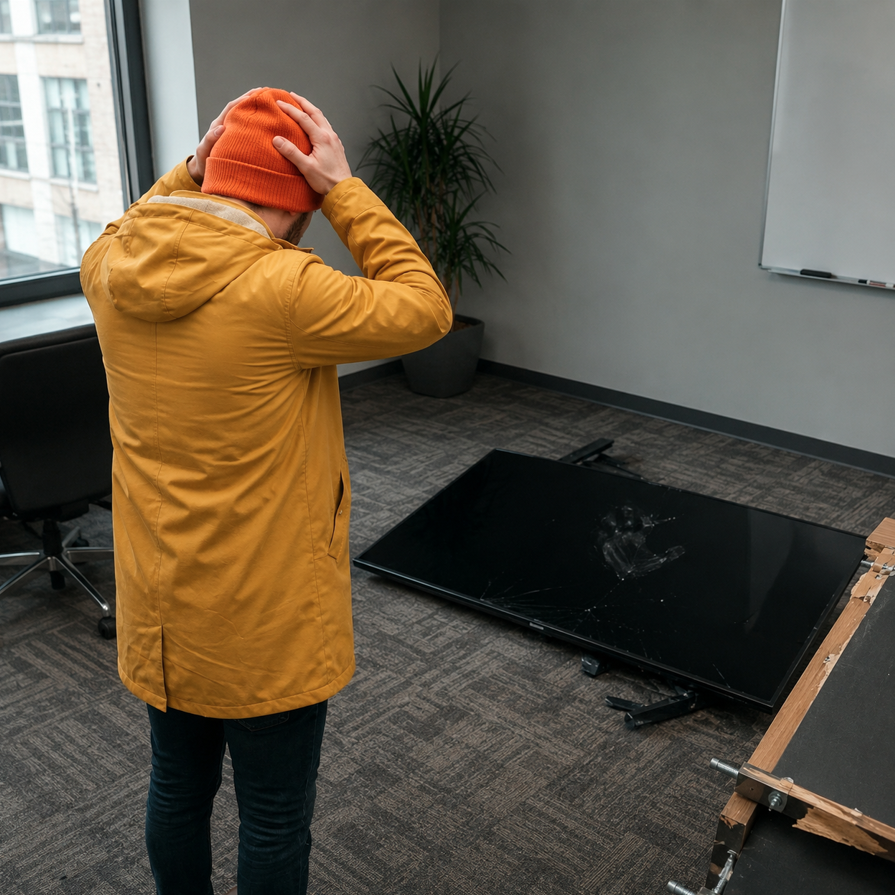
The morning began with the television on the floor of our meeting room. We lifted it back onto the table so the room would be useful again, and that is when I saw the smudge: a full palm print across the screen, left by whoever had handled it the day before.
It had been on the floor because of an exam. We use that room for remote certification exams as well as meetings, and the day before, a proctor watching through the camera had asked the candidate to show the whole room and then to take the television down. So it spent the night on the carpet.
The television was not even ours. Our executive director had brought it in a couple of weeks earlier, while moving between apartments, because it was easier to leave it at the office for a while. The room is large, so it went on the table. Nobody checked whether the table could hold it. It looked like a table. That was enough.
The smudge bothered me more than it should have. Later, while I was ordering new headphones and keyboards for the office, I remembered we keep special cleaning wipes in a drawer. I told our office administrator she could try them on the screen. She came in and tried. The wipes did not work well. So she took the small cloth she uses for her glasses and kept going.
At some point she sat down on the table, next to the television, to reach better. The half of the table the television stood on tore out of its fittings. The television went over the edge and onto the floor. It did not survive.
She was badly frightened, and she was sure it was her fault. It was not. She had sat down with a cloth to clean a screen, and there was nothing she could have seen to warn her. No intention, just an ordinary movement on a surface that looked safe. The director came in, was shaken for a few minutes, then settled himself quickly and said there would be better televisions in the future and that this was something to forget. Now the set has to be written off, and the corner of the table has to be repaired again.
Again, because it had been repaired before. The top was a particleboard panel, and it had barely been fastened down. When it tore out, I could see the old work: extra bolts driven in where a table does not normally have bolts. Someone, at some point, had already fixed this table and decided it was fine. The expensive thing had been standing on something weak the entire time, and no one could see it from the outside. It looked like a solid surface. That was enough, until it was not.
For a moment after it fell, the room stopped feeling reliable. The table had looked like a table. The surface had looked like a surface. Now I could not be sure what else around me was only holding because no one had leaned on it yet. I looked at the rest of the furniture differently for a few seconds, scanning for the next weak thing.
That reaction passed. What stayed was narrower. It was not the table, and not the old repair, and not the rest of the room. It was the wipes.
I did not break the television. The causes were elsewhere: a personal set in a room that was never meant to hold it, a table repaired badly long ago, an exam rule that moved it up and down, a screen that happened to need cleaning. I can name all of it. The logic is clear, and none of it points at me.
And still I cannot honestly say it had nothing to do with me. I suggested the wipes. Without that small, ordinary, helpful suggestion, this exact sequence might not have run today. My hand was in the chain. Not at the start of it, not as the cause of it, but in it.
That is a very thin kind of guilt. Logic cannot confirm it, because logic puts the cause somewhere else. But logic cannot switch it off either, because the participation was real. It is not a catastrophe. It is closer to a bee sting: small, sharp, unfair, the kind of thing that punctures an ordinary afternoon and then keeps aching after the day has moved on. I am not saying "I broke it." I am saying something closer to "I was part of the path that ended with it broken." Those are not the same sentence.
I notice the same gap in how failures get assigned. The person who looks responsible is usually the one who was nearest when the failure surfaced, not the one who built the weakness in long before. The story will be that someone was cleaning the screen when it fell. It will not be that a panel had been barely fastened for years. The recent hand is easy to see. The old repair is not.
A person can be genuinely innocent of the cause and still carry the weight, because they were close enough to be part of the sequence. The cleaning cloth was real. The smudge was real. The suggestion was mine.
The honest position is the uncomfortable one. Not "this is my fault." Not "this has nothing to do with me." Something in between, with no clean exit, where my hand was in the chain and the chain ended badly and both are true at the same time.